Choose a no-cutting body kit by the recipient vehicle, the stated installation version and the itemized package. Use before-and-after photos to judge the appearance, then use the component list and quote to decide what you are buying. Those records answer different questions, and all of them matter.
A conversion photo may show new wheels, a different paint color and extra trim beside the body kit. It is easy to read that whole finished car as the product. Before comparing prices, break the project into supplied parts and separately arranged work.
What does a no-cutting body kit description establish?
It identifies the stated installation design of a specific kit version. It does not, by itself, confirm wiring, coding, paint readiness, labor time or every part included in the shipment. Match the no-cutting statement to the exact product you are ordering and request a fitting plan for your recipient vehicle.
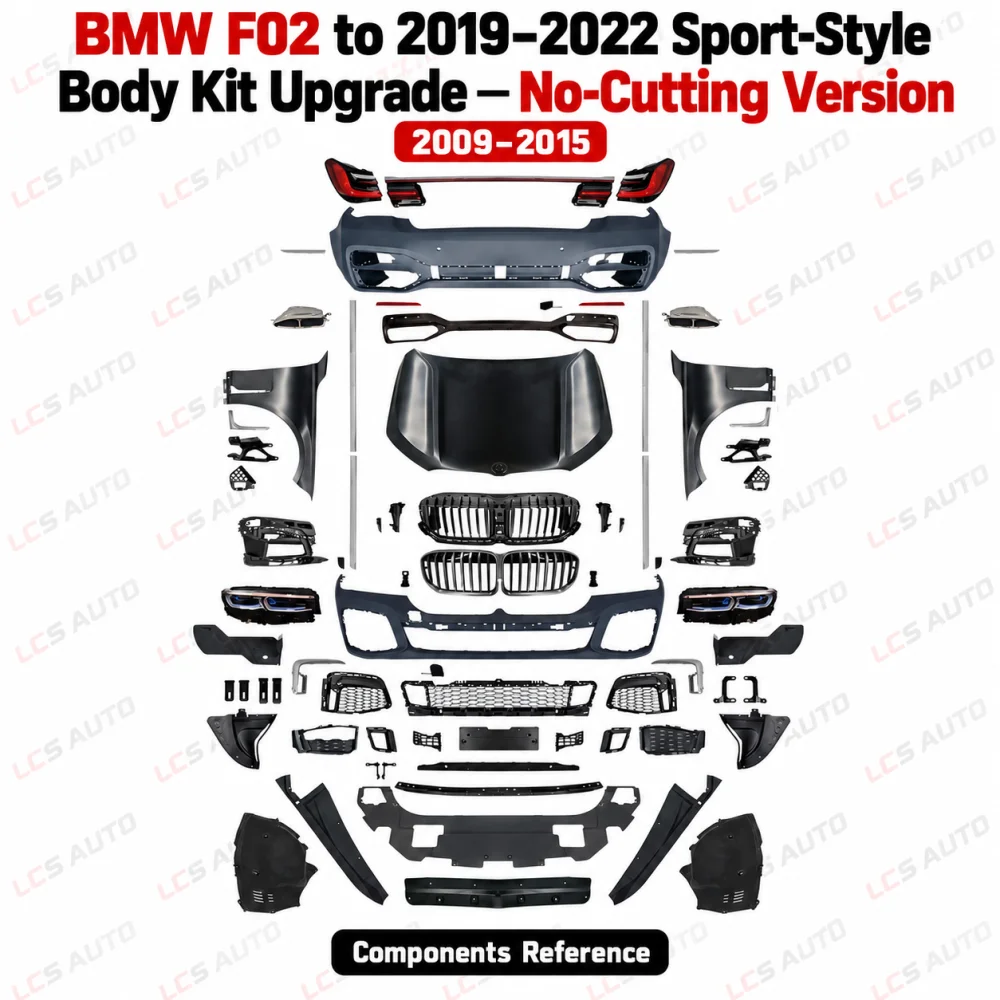
For example, LCS Auto identifies the F02 2019–2022 Sport-style package as no-cutting. That statement is attached to that version. It should not be used to describe another F02 kit with a different styling target or a Mercedes SUV kit on a different chassis.
Compare these four catalog references correctly
| Recipient vehicle | Listed appearance | Where to check the scope |
|---|---|---|
| F10/F18, 2011–2017 | 2024+ G60/G68 M-Tech style | F10/F18 no-cutting kit |
| F02, 2009–2015 | 2019–2022 Sport style | F02 no-cutting kit |
| ML/GLE W166, 2012–2019 | 2024+ GLE AMG63 style | W166 no-cutting kit |
| W213, 2016–2023 | W214 AMG53 style | W213 conversion guide |
These are recipient-specific examples, not interchangeable packages or a ranking of which one is best. If your car is absent from the stated recipient range, ask about a suitable listing. Don’t broaden a fitment claim because the target appearance looks close.
Use photos for appearance and lists for supply
Look at the front and rear comparisons together. Note the grille shape, bumper treatment and lighting appearance you want. Then check whether the corresponding assemblies appear in the package description. A front-only product will not give you a complete rear transformation simply because a finished vehicle is shown elsewhere.
Ask about any accessory that is visible only on the example car. Wheels, tires, paintwork and performance modifications are not automatically supplied. Styling exhaust tips should also be distinguished from a complete exhaust system. Keep those decisions outside the kit comparison until you have a separate specification.
Turn a component photo into a quote checklist
The F10/F18 product explicitly lists headlights, front bumper, grille, hood, fenders, side skirts, taillights, rear bumper and trunk lid. The F02 reference names different principal groups, including a rear diffuser and exhaust tips. The W166 page asks buyers to confirm the exact supplied configuration with customer service.
That difference is useful. It tells you why “full kit” is too vague for comparing orders. Request the final large-assembly list, then ask which brackets, trims and connectors are included. Mark anything reused from the car or sourced by the workshop as a separate responsibility.
Compare a complete project budget
These LCS Auto exterior conversions use personalized inquiry pricing. Ask for the selected package and shipping to your destination, then request a workshop estimate. Don’t use a kit-only quote as the installed project cost.
| Cost line | Question to ask |
|---|---|
| Kit supply | Does the amount cover the confirmed itemized configuration? |
| Shipping | What destination and delivery terms does the quote cover? |
| Workshop work | What trial fitting, painting and assembly are included? |
| Equipment integration | Which lighting, sensor or adapter tasks are separately priced? |
Where the quote doesn’t answer a question, leave it open rather than filling in an assumed promise. Ask about availability and the expected dispatch arrangement for the selected configuration. A price comparison becomes useful only after both offers describe the same job.
Make the inquiry easy to match
Send the chassis, model year and clear current front, rear and side photos. Add the product link or SKU, the styling version you want and the delivery destination. Include the original equipment relevant to the conversion, such as the existing lamps and bumper sensors.
Ask customer service for one final package record that your installer can review. If you later change the appearance target or add parts, update that record before ordering. It keeps the discussion attached to a single configuration instead of a collection of unrelated screenshots.
No-cutting body kit FAQ
Is the newest-looking conversion always the right choice?
The right choice matches your recipient chassis, desired appearance and installation scope. A newer styling reference does not establish fitment or a no-cutting design.
Does an AMG or M-style kit change performance?
The cited packages describe exterior styling. Their names don’t establish an engine upgrade or genuine factory performance-model status.
Should I order before the installer sees the quote?
Have the installer review the proposed configuration and fitting responsibilities first. That gives both sides a chance to resolve missing information before the car is dismantled.
Choose a package with a defined scope
Browse LCS Auto exterior parts and select by recipient chassis. Bring the product link, component list and current vehicle photos to the same conversation with customer service and your body shop. You can then judge the appearance you want against the actual parts and work needed to achieve it.
Leave a Reply