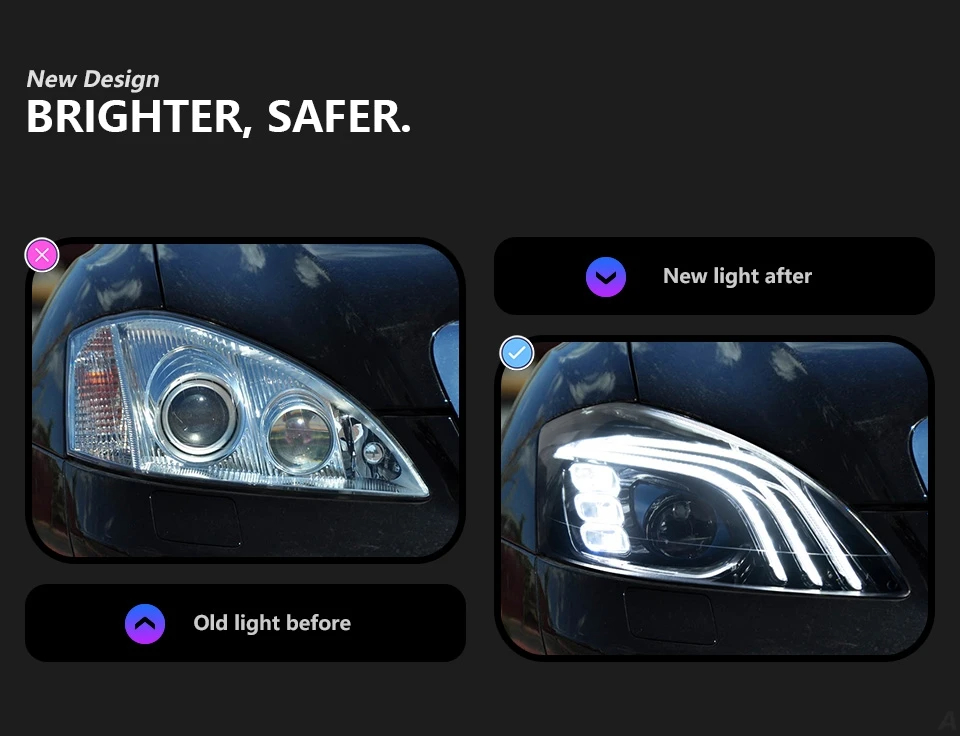
Introduction: Why Sourcing Aftermarket Headlight Assemblies is High-Risk
Automotive lighting is no longer a commodity. Modern headlight assemblies on European luxury vehicles — a BMW G20, a Mercedes-Benz W213, an Audi B9 A4 — contain adaptive LED matrices, integrated CAN-bus modules, lane projection systems, and multi-zone DRL logic. A single assembly can carry an OEM list price north of $1,200 USD.
The aftermarket alternative looks attractive on paper: 40–70% below OEM price, shipped from stock, available across platforms. But in practice, the aftermarket lighting category carries a disproportionately high defect and return rate. A 2024 analysis of BBB complaints and professional automotive forums revealed that the vast majority of disputes involve five recurring failure categories — all of which are predictable, and all of which are preventable if you know what to ask your supplier.
This article is written for importers, workshop owners, and trade resellers who want to stop absorbing those losses.
Pain Point #1: Fitment Failure — The Assembly That “Almost” Fits
What buyers experience
The assembly arrives. It looks right. The installer starts the job — and discovers the mounting tabs are 3mm off, the wiring harness uses a different connector pinout, or the amber turn signal module sits 5mm too far forward, creating a visible gap at the grille interface. The car goes back to the customer with a botched install or a panel gap that screams “aftermarket.”
This is the #1 category of aftermarket headlight complaints, and it’s particularly severe on European platforms where panel tolerances are sub-millimeter and where different production years — or even different trim levels — can use completely different harness connectors.
A BMW F30 3-Series built before the LCI facelift uses a different low-beam projection lens and a different AHL motor than the post-LCI version. An Audi B9 A4 with the Matrix LED option routes different CAN signals than the standard Xenon variant. These are not minor variations — they define whether your assembly will work at all.
What to demand from your supplier
- Chassis-code level specificity: Not just “BMW 3-Series.” You need F30 vs. G20, pre-LCI vs. post-LCI, and the specific electrical package (standard LED / Adaptive LED / Laserlight).
- Pre-shipment fitment verification: A serious factory-direct supplier will cross-reference your vehicle’s chassis code and production date before confirming the SKU. This is not optional — it is the baseline.
- Plug-and-play harness compatibility: Connectors must match OEM pinout. Any assembly requiring wire splicing or third-party adapter looms is a defect risk waiting to materialize.
How LCS Auto Addresses This
Every LCS Auto order is accompanied by a pre-sale fitment check conducted by our technical team. Trade partners submit their target chassis code, production year, and trim specification — and we confirm the correct SKU before invoicing. Our 150+ vehicle model coverage is built on OEM reference data, not generic catalog matching. If we cannot confirm a 1:1 fitment match, we say so before the order is placed.
Pain Point #2: Condensation and Moisture Ingress — The Slow Defect
What buyers experience
The install looks perfect. The customer drives away happy. Three weeks later, the headlight lens has a cloud of condensation building up inside. Six weeks in, there is visible standing water at the bottom of the housing. By this point, the electrical board is corroding, the LED strips are flickering, and the customer is filing a warranty claim that costs you the part, the labor, and the relationship.
Condensation inside a sealed headlight housing is not normal operation — it is a sealing failure. It happens when the lens-to-housing bond or the gasket between the main housing and the rear access cover is insufficient. On cheap assemblies, this manifests within weeks because:
- The adhesive butyl tape used to bond the lens is too thin or applied inconsistently.
- The rear rubber access grommet is undersized, leaving micro-gaps where wiring enters.
- The housing plastic is injection-molded with slight warping that prevents a flush seal.
Moisture-related failures are particularly insidious because they are slow: by the time the defect is visible, the return window at most budget suppliers has closed.
What to demand from your supplier
- IP-rated housing sealing: Ask for the sealing specification on the housing bond. OEM assemblies on BMW and Mercedes-Benz units are typically sealed to IP67 or IP68 standard.
- Anti-fog venting membrane: Quality assemblies use a Gore-Tex style breathable vent membrane — it allows pressure equalization (which prevents condensation cycle) while blocking liquid ingress. This is a visible component; ask to see it on sample photos.
- Full assembly testing at the factory: Not just visual inspection — functional moisture cycling where the unit undergoes temperature and humidity simulation before shipment.
How LCS Auto Addresses This
LCS Auto assemblies use factory-grade butyl adhesive bonding on lens joints and include properly sized breathable vent membranes on every housing. Our multi-stage quality inspection includes leak verification on finished units. The 12-month warranty we provide covers moisture ingress as a manufacturing defect — not just cosmetic issues. If a unit fails from condensation within the warranty period, our after-sales team replaces the part directly without redirecting you to a third-party claims process.
Pain Point #3: Electrical Compatibility and CAN-Bus Errors — The Ghost in the System
What buyers experience
The headlight assembly fits. The seals are good. But the moment the installer turns on the ignition: the dashboard throws a “Lighting Fault” error. The left DRL flickers at startup. The high beam won’t engage via the steering column stalk. The adaptive leveling motor throws an “actuator timeout” code in the OBD system.
These are CAN-bus and BCM incompatibility failures, and they are the most technically complex defect category in the aftermarket lighting segment. Modern European vehicles — particularly BMW F/G series, Mercedes-Benz W205/W213, and Audi B8/B9 chassis — communicate with headlight modules via the body control module (BCM) over a LIN or CAN bus network. The lighting assembly is not a passive electrical load — it is an intelligent node that the BCM actively queries, programs, and monitors.
An assembly built with the wrong module firmware, incorrect CAN node address, or missing LIN slave logic will throw persistent fault codes that cannot be cleared without replacing the assembly or reprogramming the unit.
This is also why hyper-flashing on LED tail lights occurs: the BCM monitors turn signal current draw, and an LED assembly that does not include a load equalizer or OEM-equivalent resistor pack will cause the BCM to flag a “bulb out” condition and increase flash rate as a driver warning.
What to demand from your supplier
- CAN-bus compliant module firmware: Ask whether the assembly includes an integrated control module with OEM-matching communication logic — not just an LED driver board.
- BCM coding support: For BMW AHL, Mercedes-Benz FLA/IHC, and Audi MMI-integrated systems, initial coding via ISTA+, Xentry, or VCDS is required to activate adaptive features. A credible supplier should offer remote coding guidance.
- Load-equalized turn signal output: For tail light assemblies on vehicles with incandescent reference signals, the assembly should include integrated resistors or an OEM-equivalent current profile to prevent hyper-flash.
How LCS Auto Addresses This
Our engineering team provides remote coding support for all BMW F/G chassis, Mercedes-Benz W205/W213, and Audi B9/C8 platforms — covering CAN-bus module initialization, BCM programming, and DRL logic configuration. This is not a premium add-on: it is part of every B2B order. As noted by one of our trade partners in Italy: “The technical team helped us with W205 coding issues after installation. That kind of post-sale support is almost unheard of at factory prices.”
Pain Point #4: UV Degradation and Build Quality — The Three-Month Reveal
What buyers experience
The initial quality looks acceptable. But at the three-to-six month mark, your customer notices the lens is developing a slight haze. Within a year, the polycarbonate lens has turned milky-yellow, the chrome reflector trim has oxidized, and the housing ABS plastic has developed micro-cracking along stress points. The assembly that looked premium in the listing photo has become an accelerated aging experiment.
UV degradation in plastic headlight components is a function of material grade and coating quality. OEM lens polycarbonate uses UV-stabilized resin and is then hard-coated with a UV-resistant lacquer layer. A budget aftermarket unit will use a lower-grade PC resin with a thinner coating — or no UV-hard coat at all. Under sustained solar exposure, particularly in high-UV environments (Middle East, Southern Europe, Australia), the degradation timeline is dramatically compressed.
This failure mode is especially damaging for trade resellers because it sits outside the typical 30–90 day return window of most marketplace sellers, but well within the ownership period where customers associate the failure with your shop’s recommendation.
What to demand from your supplier
- Material specification data: Ask for the PC resin grade and UV coating process. OEM-equivalent materials use multi-stage UV-hard coating applied post-molding.
- Accelerated weathering test results: Reputable manufacturers will have ISO 4892-3 or equivalent UV exposure test data for their housing and lens materials.
- Sample testing before bulk ordering: The MOQ-1 model exists precisely to let you evaluate real-world material quality before committing to volume.
How LCS Auto Addresses This
All LCS Auto lens units are manufactured using OEM-equivalent UV-stabilized polycarbonate with multi-layer hard coating applied using the same process specifications as the original equipment. Our Guangdong manufacturing facility operates under quality management protocols that require material certification on incoming resin batches. Our MOQ-1 policy is not just a commercial convenience — it is an open invitation to verify material quality on a live sample before scaling your order.
Pain Point #5: Warranty in Name Only — The After-Sale Abandonment
What buyers experience
A unit fails within the warranty period. The buyer contacts the seller. The response: “Send us a video of the defect.” Then: “Our team is reviewing.” Then silence. Or a counter-offer: “We can offer 10% refund on your next order.” Or the most common outcome: the seller has disappeared from the platform entirely, replaced by a new storefront with a similar name and the same product photos.
In the aftermarket lighting category, warranty is where supplier quality becomes seller integrity. A 12-month warranty from a supplier with no technical team, no formal defect review process, and no fixed business identity is worth less than the paper it’s printed on. This is not a hypothetical — the BBB complaint database for aftermarket auto lighting runs to thousands of unresolved entries, with the recurring theme of warranty terms that exist only in the listing description.
For a B2B buyer — an importer, a distributor, a workshop owner — a warranty failure does not just cost the part value. It costs the labor to pull and reinstall, the customer relationship, and the shop’s reputation. The true cost of a failed warranty claim is typically 3–5x the part price when all factors are included.
What to demand from your supplier
- Named after-sales engineering team: Not a returns department — a technical team. You need someone who can diagnose the failure mode, not just process a return ticket.
- Clearly defined defect protocol: How is a warranty claim initiated? What documentation is required? What is the average resolution time?
- Fixed business identity and verifiable track record: Factory address, business registration, international trade history. A supplier you can visit — or audit — is a supplier with skin in the game.
How LCS Auto Addresses This
LCS Auto’s 12-month warranty is serviced by our in-house after-sales engineering team — the same engineers who provide pre-sale coding and fitment support. Defect handling follows a defined protocol: photographic submission, technical review within 48 hours, and replacement authorization or technical resolution. We are a registered manufacturing entity in Guangdong with a fixed factory address (Chaohua Technology Industrial Park, Baiyun District, Guangzhou) and an active B2B trading history with 1,000+ verified trade partners across 40+ countries. We are auditable, contactable, and accountable.
Summary: The Supplier Checklist That Actually Matters
Before your next headlight or tail light assembly purchase, run your supplier against this checklist:
| Requirement | What to Ask | LCS Auto Standard |
|---|---|---|
| Fitment Verification | “Can you confirm 1:1 fitment for my chassis code before I order?” | ✅ Pre-sale check, every order |
| Moisture Sealing | “What is the housing seal rating and venting solution?” | ✅ IP-grade bond, breathable vent membrane |
| CAN-Bus Compatibility | “Does the module match OEM CAN/LIN logic?” | ✅ OEM-equivalent module firmware |
| After-Sale Coding | “Can your team support BCM coding post-installation?” | ✅ Remote coding support included |
| Material Grade | “What is the lens PC resin grade and UV coating spec?” | ✅ OEM-equivalent UV-stabilized PC |
| Warranty Enforcement | “Who handles defect claims — your team or a third party?” | ✅ In-house engineering team, 48h response |
| Business Verifiability | “Can you provide factory address and trade history?” | ✅ Fixed Guangzhou factory, 1,000+ partners |
Ready to Source Without the Risk?
LCS Auto (LCS Auto) is a B2B factory-direct supplier of 1:1 OEM-equivalent headlight and tail light assemblies for BMW, Mercedes-Benz, Audi, Porsche, Volkswagen, Toyota, and more. We ship DDP to 40+ countries with a 12-month parts warranty on every unit.
MOQ is 1 set — so you can verify fitment, quality, and market performance before scaling. Our technical team handles pre-sale compatibility checks and post-installation coding support as standard.
Chaohua Technology Industrial Park, Baiyun District, Guangzhou, Guangdong, China
Email: [email protected] | Website: lcsauto.com
Browse factory-direct assemblies: BMW, Mercedes-Benz and Audi headlight assemblies, plus DRL modules — all OEM-grade with 1-set MOQ and 12-month warranty.
Leave a Reply